Multiplayer
Multiplayer web games bring players into a shared experience through their browsers. A backend connects their sessions, exchanges game state, and decides which actions count.
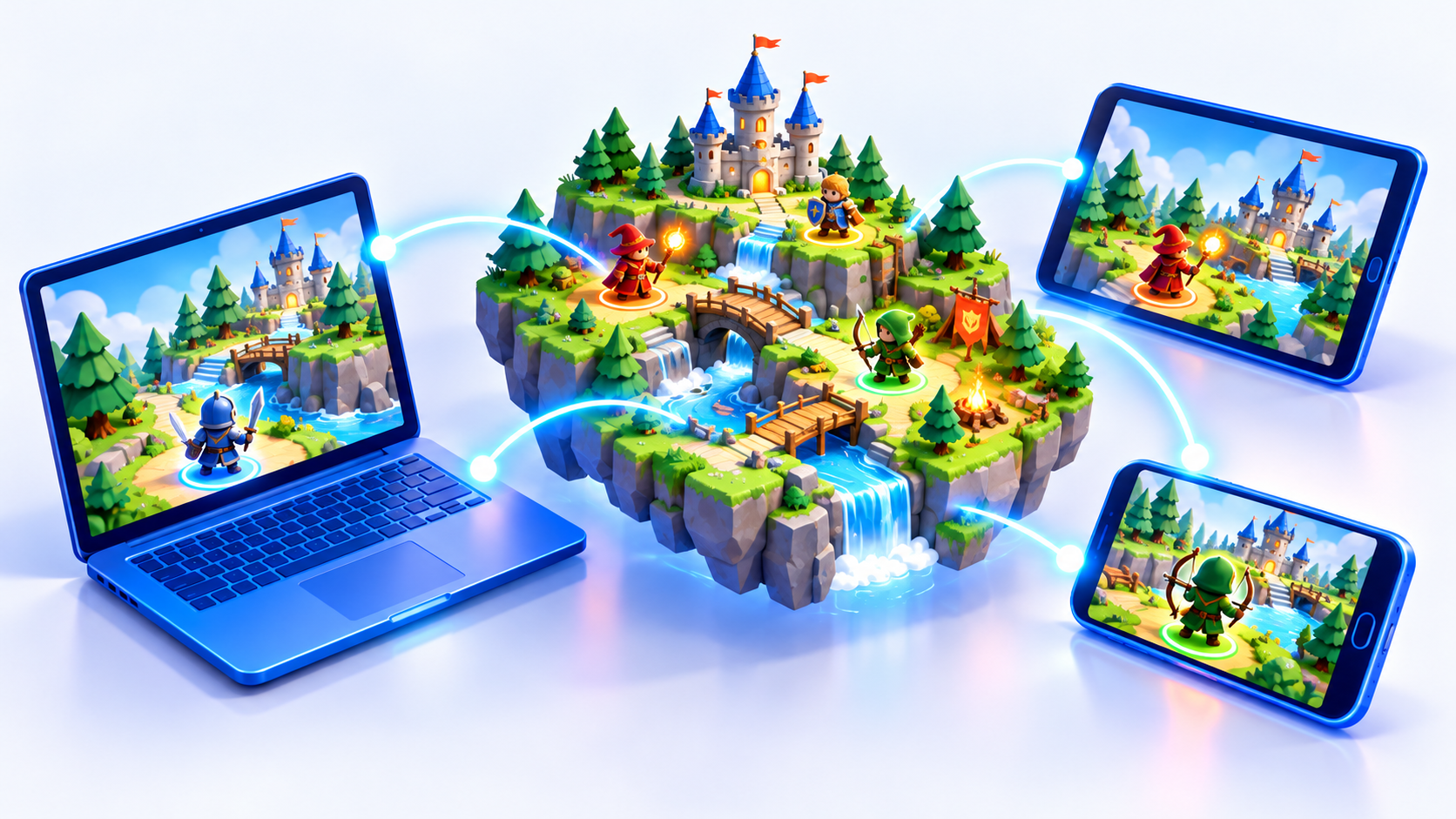
One world. Shared rules.
The browser draws the game and captures each player's input. The backend keeps players connected and coordinates what happens next. For competitive play, an authoritative server validates actions and owns the game state. A turn-based card game and a fast-moving arena need different update rates, networking, and recovery when a connection drops.
Backend options
Here are backend options to power your multiplayer experience.
| Name | Description | What to check |
|---|---|---|
| Boardgame.io | Turn-based games with shared rules and state. | Check hidden state, logins, and saved games. |
| Colyseus | TypeScript multiplayer server. | Check tick rate, server validation, and hosting. |
| Geckos.io | WebRTC networking for fast-moving games. | Check UDP hosting, STUN/TURN, and state sync. |
| Nakama | Accounts, matchmaking, and multiplayer matches. | Plan match authority, storage, and hosting. |
| Nengi | Game-state sync and player prediction. | Match SDK, adapter, and documentation versions. |
| PartyServer | Room-based WebSockets on Cloudflare. | Check room limits and Cloudflare quotas. |
| Photon Realtime | Hosted rooms, matchmaking, and messaging. | Check player limits, traffic, and pricing. |
| SmartFoxServer 2X | Game rooms, matchmaking, and social tools. | Check licenses, hosting, and WebSocket setup. |
| Socket.IO | Realtime messaging, rooms, and reconnection. | Plan game rules, state sync, and latency handling. |
| SpacetimeDB | Game logic and live state in one database. | Plan permissions, subscriptions, and deployment. |
Engine choices for multiplayer
All of these engines support multiplayer gaming. Choose your engine first, then select a compatible backend from the options above.

Babylon Lite
A WebGPU-only 3D engine from the Babylon family, built as a tree-shakable, data-oriented renderer. Its modern GPU foundation focuses on small bundles and high-performance graphics.
Defold
A free, turn-key game engine that brings its editor, runtime, scripting, build pipeline, and deployment tools into one workflow. Create component-based 2D or 3D games for multiple platforms.

PixiJS
An HTML5 creation engine for games, apps, and interactive digital content. Its 2D renderer uses WebGPU or WebGL to create fast, rich visuals in the browser.

PlayCanvas
An open-source JavaScript engine for building 2D and 3D web experiences. Its WebGL and WebGPU renderers, modular ES modules, and lightweight runtime support modern browsers and devices.